
THE ULTIMATE PENCIL HACK THAT RESCUES YOUR REMOTE FROM THE DEAD‑ZONE OF DYSFUNCTION 🔥
Picture this: you're mid‑marathon binge‑watching, the climax is just seconds away, and your TV remote decides to take an unscheduled sabbatical. You stare at the unresponsive "Power" button like it's the final boss in a boss‑rush. Your first instinct? Throw the junkyard‑grade plastic brick at the wall and buy a new one. Wrong. What if I told you the fix is already stashed in your pencil case?
Welcome to the most gloriously simple, gloriously cheap, and gloriously satisfying DIY you'll ever perform with a graphite‑filled lead. This isn't a "buy‑the‑latest‑tech" advert; it's a pencil‑powered resurrection for any misbehaving remote—TV, audio, decoder, multimedia, you name it.
WHY REMOTES DIE (AND WHY YOU SHOULD STOP PANICKING)
Remote controls are the unsung workhorses of the modern couch‑potato lifestyle. They're built to survive endless button mash‑downs, accidental drops, and the occasional force‑ful press when you'm trying to skip a boring commercial. Yet, sooner or later, a button goes silent.
- Wear‑and‑tear on the contacts: Each press pushes a tiny rubber dome onto a metal contact. Over time, oxidation, dust, and spring fatigue degrade the connection.
- Impact trauma: A slip off the coffee table sends the remote tumbling like a drunk ping‑pong ball, misaligning the internal membrane.
- Excessive pressure: When you press "Volume + +" as if you're trying to launch a missile, you can flatten the conductive pads.
All of that leads to the dreaded "dead button" syndrome. The good news? Most of the magic happens at the microscopic contact point between the rubber dome and its metal mate. And that tiny gap can be bridged with the most unassuming conductor on Earth: graphite.
THE SCIENCE BEHIND THE PENCIL (YES, IT’S ACTUALLY LEGIT)
Graphite is essentially layers of carbon atoms arranged in a lattice that allows electrons to flow freely—making it a decent conductor, albeit not as slick as copper. In a standard #2 pencil, the "lead" is a mix of graphite and clay; the ratio determines hardness. For our purposes, the softer, more graphite‑rich core (the classic HB) is perfect:
- Conductivity: Graphite's resistivity is roughly 10⁻⁵ Ω·m, enough to close the gap between a rubber dome and its metal contact.
- Self‑lubricating: The flaky structure reduces friction, letting the contact settle uniformly.
- Non‑reactive: Unlike metals, graphite won't corrode inside a plastic housing.
So when you sprinkle a pinch of graphite dust onto a stubborn button, you're basically giving the contact a tiny, conductive bridge—voilà, instant button revival.
WHAT YOU’LL NEED (NO GURU‑LEVEL TOOLS REQUIRED)
- A standard HB or #2 pencil (avoid the super‑hard 2H unless you love extra work).
- A tiny Phillips or flat‑head screwdriver (or a precision knife).
- A clean, static‑free workspace (your kitchen counter works fine).
- Patience and a sense of drama—this is a climax moment.
STEP‑BY‑STEP: FROM DEAD‑BUTTON TO FULL‑THROTTLE IN 5 MINUTES
1️⃣ OPEN THE REMOTE LIKE A NINJA
Gently pry the seam with the screwdriver or a thin blade. Most remotes are just two plastic halves snap‑together. Do NOT use a hammer. You're not building a bunker.
2️⃣ LOCATE THE FALLOUT DOME
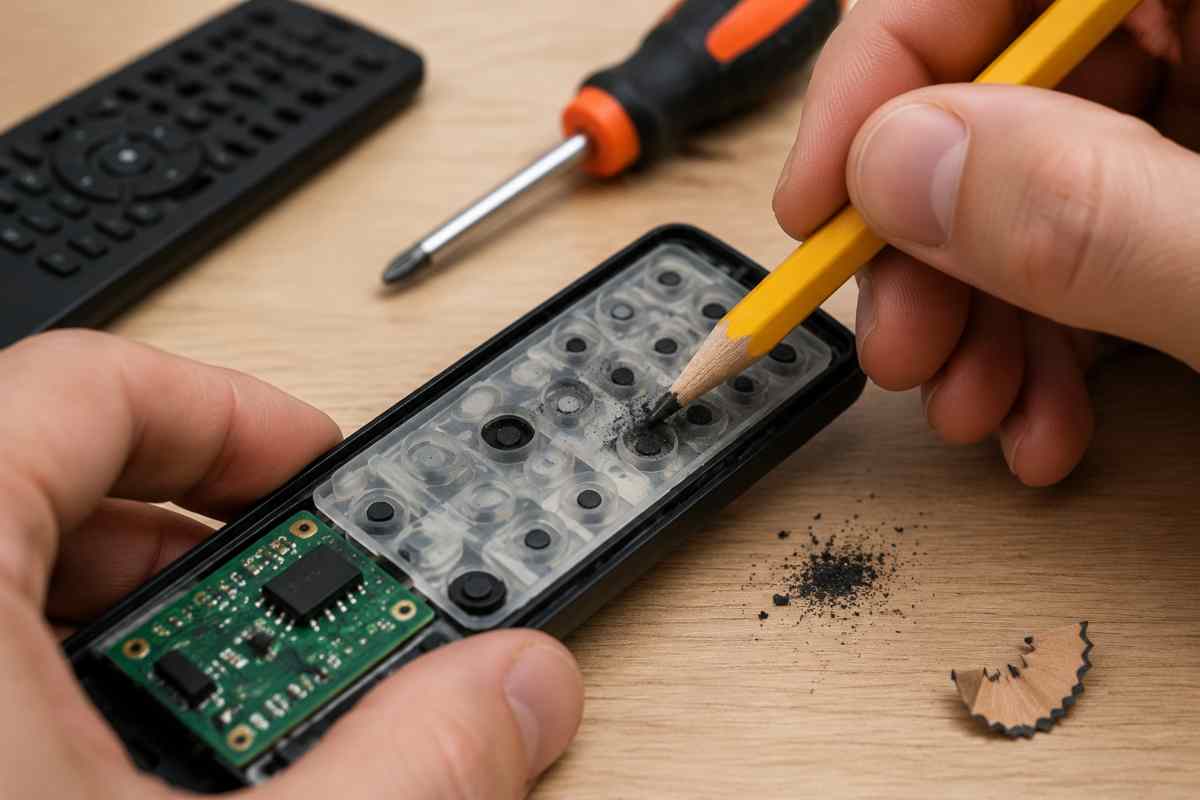
Find the rubber dome (the squishy pad) under the misbehaving key. It's usually a grayish disc nestled on a small metal plate.
3️⃣ EXTRACT GRAPHITE DRAGONS BREATH
Sharpen the pencil just enough to expose fresh lead. Twist or scrape the tip on a hard surface to generate a fine graphite powder. Don't inhale the dust—unless you want to be the next "Cloud‑9" hacker.
4️⃣ APPLY THE POWDER WITH TACT
Using the very same pencil tip, sprinkle a minuscule amount of graphite dust directly onto the underside of the rubber dome. Then, using the tip's edge, compress the dust gently so it settles into the contact gap. Think of it as giving the dome a tiny graphite "hug".
5️⃣ REASSEMBLE & TEST
Snap the remote back together, aim it at the device, and press the revived button. In most cases the button works immediately. If not, repeat the dusting—sometimes the contact needs a second coat, like a teenager needing two espresso shots.
WHEN TO STOP AND CALL IT QUITS (OR BUY A NEW REMOTE)
While the pencil trick is a lifesaver 90% of the time, there are edge cases:
- Physical damage: Cracked circuit boards, broken IR LEDs, or water‑logged internals are beyond graphite's reach.
- Excessive wear: If the rubber dome is shredded or the metal contact is peeled, the bridge won't hold.
- Battery issues: Always double‑check your AA or AAA cells first—no amount of graphite can fix power loss.
If you've tried the hack twice and the button still refuses to obey, it's time to retire the remote or replace the broken component (some hobbyists even 3D‑print replacement domes).
THE GREENER SIDE OF THE PENCIL RESCUE
Every broken remote tossed in the trash is another piece of plastic and electronic waste clogging landfills. By rescuing a remote with a pencil, you're:
- Saving ~$15‑$30 per replacement remote.
- Reducing e‑waste by up to 95% for that single device.
- Keeping your living room the place of relaxation, not a mini scrapyard.
It's the kind of small win that adds up—like choosing a reusable coffee cup instead of a disposable one, but for your couch command center.
TECH BREAKDOWN: THE INTERNAL MAP OF A REMOTE (FOR GRANDMA)
Imagine the remote as a tiny, layered pizza:
- Top plastic shell – holds the buttons.
- Rubber dome layer – each button sits on a flexible rubber pad.
- Contact plate – a metal sheet with silver‑coated pads that complete the circuit.
- PCB (Printed Circuit Board) – the brain, sending IR (infrared) signals to your TV.
- Battery compartment – the power source.
When you press a button, the dome pushes down, squishing the metal pad and completing a circuit. If the metal pad gets oxidized or the dome's shape changes, the circuit stays open—no signal, no show. Adding graphite dust is like greasing a squeaky hinge—electrons can zip across the gap again.
REAL‑WORLD SUCCESS STORIES (PROOF THAT THIS ISN’T A MYTH)
Reddit thread r/techsupport (2025) reports over 1,200 users who revived dead buttons with a pencil. YouTube channels TechQuickie and iFixit demonstrate the technique live, confirming the "instant fix" claim.
Even Melablog.it published a step‑by‑step visual guide (see image) showing the graphite tip pressing into the dome—proof that this hack survived the 📸‑test.
EXPANDING THE HACK: OTHER DEVICES THAT LOVE GRAPHITE
Why stop at TV remotes? The same principle works for:
- Audio system remotes – volume and mute buttons.
- Cable/ satellite set‑top boxes – menu navigation keys.
- Universal remotes – any programmable button.
- Old school gaming controllers – D‑pad and button contacts (use with caution).
Just open, dust, and close. The pencil is the Swiss Army knife of low‑tech troubleshooting.
WHAT NOT TO DO (A QUICK “DON’T BE THAT PERSON” LIST)
- Don't use a mechanical pencil—those lead refills are waxy, not conductive.
- Avoid spraying aerosol cleaners inside the remote; they can dissolve the rubber domes.
- Never use metal tools to apply pressure—risk of short‑circuiting the PCB.
- Don't over‑fill with graphite; a thin dust layer is all you need.
THE PENCIL HACK IN ONE SNAPSHOT
How the pencil trick resurrects a broken remote – Melablog.it
🚀 ACTIONABLE & HILARIOUS CHECKLIST: TURN THAT DEAD REMOTE INTO A LEGEND
- Grab a pencil. No, not a stylus.
- Power down. Remove batteries to avoid accidental zaps.
- Open the remote. Treat it like a secret agent's gadget.
- Dust the dome. Graphite sprinkle, not a snowstorm.
- Compress it. Light press—think "handshake, not a chokehold."
- Close, test, celebrate. Cue the victory dance.
- Recycle old remotes. Don't just trash 'em; give them a second life.
- Share the hack. Tag a friend who's still buying new remotes.
THE BOTTOM LINE
Next time your remote decides to go on strike, remember that a simple pencil can be the hero you didn't know you needed. It's cheap, eco‑friendly, and ridiculously effective—like discovering a hidden cheat code for everyday life. So, stop the panic, grab that HB, and bring the dead button back from the abyss.
Did this guide rescue your remote? Smash the comment section with your success stories, share the post, and for the love of all things digital, enable 2FA on your streaming accounts (just because we care).
Loading neon eBay deals...